Polsko! Ojczyzno Nasza!
Jak nisko upadłaś!
Żydowska premier RP Beata Szydło błogosławiona przez żydowskiego chuligana!
Wypędzenie Karmelitanek z Oświęcimia to nasz grzech pierworodny, to apostazja!
Tu w tym obłędzie tej nikczemnej idiotki premier – premier rządu, który rządzi Polską(!) - Beaty Szydło jest to absolutnie jasno widoczne.
To obecne wypędzanie Polaków z Polski, najazd ludożerców ukraińskich, ma charakter mistyczny - to Bicz Boży na nasze plecy za nasz grzech przeciwko Panu Jezusowi Chrystusowi, za nasz grzech przeciwko cichym siostrom Karmelitankom. Bo bluźnierczo, zdradziecko oddaliśmy żydom ten skrawek Polski. A z tego skrawka ziemi żydzi zrobili sobie wielką bramę żydowskiego najazdu na Polskę.
A Oświęcim to szczególna ziemia Jezusa Chrystusa Pana Naszego.
Polska musi przeprosić Pana Boga, przeprosić Siostry.
W ramach pokuty musimy wypędzić żydów z Klasztoru, który zagrabili Karmelitankom.
A w samym obozie należy postawić świątynię katolicka, w której będzie można się godnie modlić za ofiary tam zamordowane.
Red. Gazeta Warszawska.
================
Przewodnik po młodzieży mówi, że był wielokrotnie nękany wobozie koncentracyjnym Auschwitz-Birkenau przez polskich strażników, którzy domagali się, aby on i nastolatki, których eskortował, przestali śpiewać, nawet gdy śpiewali cicho i w odległej części obozu. Zakończyło się brutalnym aresztowaniem i wysoką grzywną.
Rabin Rafi Ostroff, weteran młodzieżowy w Polsce, odwiedził w zeszły piątek były nazistowski obóz koncentracyjny z grupami szkoleniowymi ruchu World Bnei Akiva z Południowej Afryki i Australii.
"W komorach gazowych Auschwitz I zacząłem cicho śpiewać piosenkę, którą zawsze tam śpiewam," Venikiti Damam "(" A ja oczyściłem ich krew ")", mówi Ynet. "Jedna ze strażniczek zbliżyła się do mnie i zażądała, abym przestał śpiewać."
Rabin Ostroff mówi, że był zaskoczony, ponieważ po raz pierwszy został poproszony o przerwanie śpiewu, a żydowskie grupy młodzieżowe zawsze śpiewały na miejscu pamięci i duchowe piosenki, ale przestał śpiewać, aby nie wywoływać konfliktu.
"Kiedy przenieśliśmy się do drugiego pokoju, jednego z krematoriów, grupa zaczęła śpiewać" Ani Ma'amin "(" wierzę ") - dodaje. "Nagle pojawił się inny strażnik i szczekał na mnie:" Powiedz swoim ludziom, żeby się zamknęli ".
"Powiedziałem mu delikatnie:" To się skończy za 20 sekund, a potem je wyrzucę ". Ale właśnie powiedział: "Nie, teraz!" Mówił do mnie, jakbym był więźniem w jego obozie. "
Rabbi Ostroff i jego uczniowie mówią, że czuli się prześladowani podczas całej wizyty. "Faceci są bardzo wrażliwi podczas tych wizyt i czuli się wściekli i zranieni, niektórzy z nich to wnukowie ocalałych z Auschwitz, którzy dzielili się rodzinnymi opowieściami na miejscu."
Ale saga na tym się nie skończyła. "W Birkenau znów zacząłem śpiewać z mikrofonem, jak zawsze, i znowu poprosili mnie, bym przestał, a ja natychmiast się zatrzymałem, a potem, w dalszej części obozu, moja grupa stała w rzędach i zaczęła śpiewać" Ani Ma'amin 'znowu, piosenka Żydów śpiewała w drodze do komór gazowych.
"Przyjechał strażnik i zaczął nas ścigać swoim samochodem, krzycząc na nas, abyśmy przestali śpiewać, nastolatki ignorowali go i kontynuowali, ja też. W innej chacie śpiewaliśmy" Am Yisrael Chai "(" Żydzi żyją ") .
"Należy zauważyć, że robiliśmy to, co robią grupy izraelskie przez cały rok, kiedy odwiedzają to miejsce, i nie ma żadnych zakazów" - wyjaśnia rabin Ostroff.
"Kiedy wyszliśmy z kabiny, dwóch strażników zaczęło krzyczeć na mnie:" Czy jesteś przewodnikiem grupy? Zamknij je. "Odpowiedziałem, że nie mam kontroli nad sytuacją i że zamierzamy odejść za kilka sekund. "
Gwałtwne zatrzymanie
Kiedy wyszedł, rabbi Ostroff mówi, że został brutalnie zaatakowany przez strażników, którzy zażądali, aby dał im paszport.
"Odmówiłem", mówi. "Są strażnikami w obozie, a nie w policji. Zapytałem ich, czego potrzebują, a oni powiedzieli, że chcą mnie" zarejestrować ". Zgodziłam się podać im nazwę szkoły, którą prowadziłem, ale zaczęli używać przemocy przeciwko mnie, zatrzymali mnie obok studentów i nie pozwolili mi odejść, a jednocześnie wezwali polską policję. "
Według rabina Ostrowa, który pełni także funkcję przewodniczącego Rady Religijnej w Gush Etzion, "była tam grupa dorosłych, w tym ocaleni z Holokaustu, którzy byli w szoku".
Kiedy przyjechała polska policja, oficerowie nie powiedzieli ani słowa rabinowi Ostroffowi ani żadnej z jego polskich eskort. "Kiedy w końcu zwrócili się do mnie, po rozmowie ze strażnikami, natychmiast zaatakowali mnie:" Czy nie wydałeś paszportu? "
"Powiedziałem im, że nie jestem nawet pewien, czy mam przy sobie paszport, i odpowiedzieli, że to przestępstwo kryminalne i aresztowali mnie, nie słuchając nawet tego, co miałem do powiedzenia. Wsiedli mnie do pokoju i poinformowali mnie, że ukarali mnie za to, że nie okazali paszportu i "naruszali zasady strony, innymi słowy - śpiew".
Rabin otrzymał grzywnę w wysokości 1000 złotych, około 320 USD.
"Policja wyjaśniła, że jeśli nie uda mi się natychmiast zapłacić grzywny, musiałbym spędzić 24 godziny w areszcie, ponieważ przed Szabatem pozostały trzy godziny, a przed Krakowem mieliśmy dwugodzinną jazdę, zaakceptowałem wszystkie ich żądania, ponieważ nie mogłem opuścić grupy sam, daliśmy im pieniądze, podpisałem to, o co mnie prosiłem, i wyjechaliśmy do Krakowa. "
"Jak więźniowie w obozie"
Rabbi Ostroff wyjaśnia, że wolałby zostać zatrzymany na 24 godziny, ale był odpowiedzialny za grupę oczekującą na niego.
"To nie do pomyślenia, by ludzie z tak zwanego Muzeum Auschwitz byli tak niewrażliwi na grupy żydowskie", mówi. "To nie do pomyślenia, że byliby nietolerancyjni wobec Żydów śpiewających pieśni ich dziadków śpiewających w drodze do komór gazowych. Nie do pomyślenia jest, że strażnik krzyczy na nas, jakbyśmy byli więźniami w obozie, a on był kapo. czuliśmy, a studenci byli zranieni przez to.
"Po raz pierwszy tak się dzieje" - zauważa. "Stosunek do grup żydowskich stale się pogarsza i za każdym razem pojawiają się nowe restrykcje, obawiam się, że następnym razem zabronią odwiedzającym machać flagami Izraela, twierdząc, że obraża inne grupy etniczne.
"Mieszkańcy tutejszego muzeum starają się przekazać, że nie ma różnicy pomiędzy grupami żydowskimi i innymi grupami etnicznymi, które przybywają na miejsce, tak jakby to nie była historia narodu żydowskiego." Ale co możemy zrobić, że 95% zamordowani tu byli Żydzi? "
Rabin dodaje, że "są tacy przewodnicy, którzy przybywają do Polski i mówią, że wszyscy Polacy są antysemitami, którzy nas nienawidzą, a ja z drugiej strony staram się tłumaczyć moim studentom przez cały tydzień, że są dobrzy Polacy i że nie wszystkie są złe, zabrałem je na grób polskiej rodziny, część Sprawiedliwych wśród Narodów Świata.
"Całe wykształcenie, które próbowałem zaszczepić, że nie ma czarno-białego, a rzeczywistość jest skomplikowana, zostało zrujnowane".
Muzeum: Grupa zachowała się nieodpowiednio
Administracja muzeum powiedziała w odpowiedzi, że grupa zachowała się nieodpowiednio w miejscu pamięci.
"Stwarzało to problem dla innych przewodników i gości, którzy byli w tym samym czasie w miejscu .. Inni goście byli niepokojeni nawet w tak wrażliwym miejscu, jak krematorium, po tym, jak grupa opóźniła innych, którzy chcieli wejść" - czytamy w oświadczeniu.
Muzeum oskarżyło grupę o ignorowanie próśb o zachowanie ciszy w obozie Auschwitz II-Birkenau.
"Kilka wniosków od bezpieczeństwa pozostało bez odpowiedzi Szef delegacji odmówił podania nazwiska lub innych dokumentów, dlatego policja została wezwana, poprosiła o dokumenty i ukarała go za zakłócenie porządku publicznego." Nikt nie został aresztowany ".
Muzeum dodało, że incydent nie miał nic wspólnego z piosenkami, które grupa śpiewała. "Istnieją różne sposoby upamiętniania, ale nie mogą przeszkadzać innym odwiedzającym. Takie okropne zachowanie wywołuje osądzające komentarze innych odwiedzających.
"A jednak chcielibyśmy podkreślić, że większość odwiedzających - w tym grupy z Izraela - wie, jak zachowywać się w sposób odpowiedni dla miejsca pamięci, cały incydent został zarejestrowany i przeanalizowany, a reakcja personelu ochrony była właściwa w świetle sytuacja."
Tali Farkash przyczyniła się do tego sprawozdania
===================================
Rabbi detained after singing Jewish songs at Auschwitz
Veteran youth guide says he was violently attacked by Polish guards at former Nazi concentration camp, ordered by police to pay high fine or spend 24-hour in detention for 'disrupting public order.'
A youth tour guide says he was repeatedly harassed at theAuschwitz-Birkenau concentration camp by Polish guards, who demanded that he and the teens he was escorting stop singing, even when they sang quietly and in a distant part of the camp. It ended in a violent arrest and high fine.
Rabbi Rafi Ostroff, a veteran youth guide in Poland, visited the former Nazi concentration camp last Friday with training groups of the World Bnei Akiva movement from South Africa and Australia.
No Joke
Page called 'with my babes at Auschwitz' causes stir on Israeli social media, presents selfies teenagers post online while on Holocaust memorial trip to Poland death camps.
"Inside the Auschwitz I gas chambers, I began singing quietly the song I always sing there, 'Venikiti Damam' ('And I cleaned their blood')," he tells Ynet. "One of the female guards approached me and demanded that I stop singing."
Rabbi Ostroff says he was surprised, as it was the first time he had been asked to stop singing and Jewish youth groups always sing memorial and spiritual songs at the site, but he stopped singing to as not to create a conflict.
"When we moved to the other room, one of the crematoria, the group started singing 'Ani Ma'amin' ('I believe')," he adds. "Suddenly another guard came along and barked at me, 'Tell your guys to shut up.'
"I said to him gently, 'It will end in 20 seconds and then I'll take them out.' But he just said, 'No, now!' He spoke to me as if I were a prisoner in his camp."
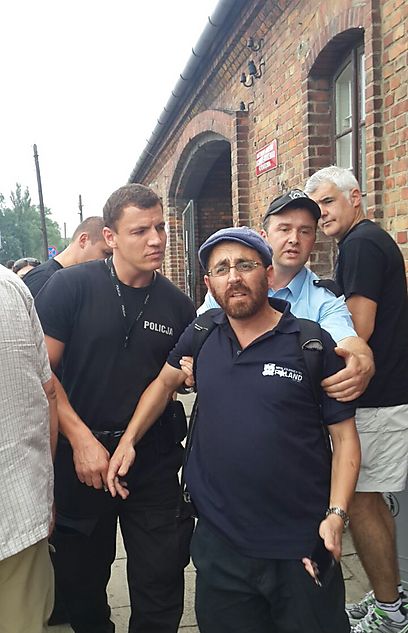
Rabbi Ostroff detained by local police in Auschwitz (Photo: Ari Chipkin)
Rabbi Ostroff and his students say they felt they were being persecuted throughout their entire visit. "The guys are very sensitive during these visits, and they felt angry and hurt. Some of them are grandchildren of Auschwitz survivors who shared their families' stories at the site."
But the saga did not end there. "In Birkenau I began singing with the microphone again, as I always do. And again they asked me to stop, and I stopped immediately. Later on, at a more distant part of the camp, my group stood in rows and began singing 'Ani Ma'amin' again, a song Jews sang on their way to the gas chambers.
"A guard arrived and began chasing us with his car, shouting at us to stop singing. The teens ignored him and went on, and so did I. In another cabin we sang 'Am Yisrael Chai' ('the Jewish people live').
"It should be noted that we did what Israeli groups do all year when they visit the place, and there are no signs forbidding it," Rabbi Ostroff clarifies.
"When we came out of the cabin, two guards began shouting at me, 'Are you the group's guide? Shut them up.' I replied that I had no control over the situation, and that we were going to leave in a few seconds."
Violent detention
When they went out, Rabbi Ostroff says, he was violently attacked by the guards, who demanded that he give them his passport.
"I refused," he says. "They are guards at a camp, not police. I asked them what they needed it for, and they said they wanted to 'register me.' I agreed to give them the name of the school I was guiding, but they began using violence against me. They detained me next to the students and wouldn't let me go, and at the same time they called the Polish police."
According to Rabbi Ostroff, who also serves as chairman of the Religious Council in Gush Etzion, "there was a group of adults there, including Holocaust survivors, who were in shock."
When the Polish police arrived, the officers did not say a word to Rabbi Ostroff or any of his Polish escorts. "When they finally turned to me, after speaking to the guards, they immediately attacked me: 'Haven't you issued a passport?'
"I told them I wasn't even sure that I had my passport on me, and they replied that it was a criminal offense and arrested me without even listening to what I had to say. They put me into a room and informed me that they were fining me for failing to present a passport and for 'violating the site's rules, in other words – the singing."
The rabbi received a fine of 1,000 zloty, about $320.
"The police clarified that if I failed to pay the fine immediately, I would have to spend 24 hours in detention. As there were three hours left before Shabbat, and we had a two-hour drive to Krakow ahead of us, I accepted all their demands because I couldn't leave the group alone. We gave them the money, I signed what I was asked to sign, and we left for Krakow."
'Like prisoners in a camp'
Rabbi Ostroff clarifies that he would have rather been detained for 24 hours, but he was responsible for the group waiting for him.
"It's unthinkable that the people of what is known as the Auschwitz Museum would be so insensitive to Jewish groups," he says. "It's unthinkable that they would be intolerant towards Jews singing the songs their grandparents sang on their way to the gas chambers. It's unthinkable that a guard would shout at us as if we were prisoners in a camp and he were the kapo. That's exactly how we felt, and the students were hurt by it.
"This is the first time this happens," he notes. "The attitude towards Jewish groups is worsening all the time, and each time there are new restrictions. I'm afraid that next time they will forbid visitors to wave flags of Israel, claiming that it offends other ethnic groups.
"The people of the museum here are trying to convey that there is no difference between the Jewish groups and other ethnic groups that arrive at the site, as if it is not the Jewish people's story. But what can we do that 95% of the prisoners murdered here were Jews?"
The rabbi adds that "there are guides who arrive in Poland and say that all the Polish people are anti-Semites who hate us. I, on the other hand, try to explain to my students all week long that there are good Poles and that they are not all bad. I took them to the grave of a Polish family, some of the Righteous Among the Nations.
"The entire education I have been trying to instill, that there is no black and white and that reality is complicated, has been ruined."
Museum: Group behaved inappropriately
The museum's administration said in response that the group had behaved inappropriately at the memorial site.
"It created a problem for other guides and visitors who were at the site at the same time. Other visitors were disturbed even at a sensitive place like the crematorium, after the group delayed others who wanted to go in," the statement read.
The museum accused the group of ignoring requests to keep quiet at the Auschwitz II-Birkenau compound.
"Several requests from security remained unanswered. The head of the delegation refused to provide his name or other documents. That's the reason why the police were called, asked for the documents and fined him for disrupting public order. No one was arrested."
The museum added that the incident had nothing to do with the songs the group sang. "There are different ways of commemoration, but they can't bother other visitors. Such awful behavior sparks judgmental comments from other visitors.
"And yet, we would like to stress that the majority of visitors – including groups from Israel – know how to behave in a way befitting the memorial site. The entire incident was recorded and analyzed, and the security personnel's reaction was appropriate in light of the situation."
Tali Farkash contributed to this report


