BLUŹNIERSTWO!
Niech Izrael będzie przeklęty, niech spłonie do ostatniego żyda!
Żydzi chcą naszej nienawiści do nich, naszych przekleństw, naszej zemsty.
Otrzymają to wszystko, a nawet więcej – obiecujemy!
Red. Gazeta Warszawska.
+++
Association for Civil Rights in Israel supports continuing exhibition in Israeli Haifa Museum of mocking “McJesus” statue. Anti-Christian hate speech is not an issue for far-Left and never an issue for adherents of Talmud, whose sacred book execrates Jesus http://talmudical.blogspot.com

Arab Christians clash violently with police in Haifa over ‘McJesus’ sculpture
3 officers wounded as hundreds of protesters try to forcibly enter Haifa Museum during demonstration against depiction of Ronald McDonald on a cross
Hundreds of Arab Christian demonstrators clashed with police in Haifa on Friday over a museum’s display of a sculpture depicting Ronald McDonald, the mascot of the fast-food giant, on a cross, amid calls to remove the artwork that some have called offensive.
Police said a few hundred protesters tried to force their way into the Haifa Museum of Art during the demonstration and that three officers were injured by rocks hurled at them.
An investigation was opened to identify the rock-throwers, and a 32-year-old resident of the city was arrested on suspicion of attacking officers.
Video from the demonstration showed scuffles as police used tear gas and stun grenades to clear the protesters.
One of the protesters complained that the government was slow to react to their concerns because they were from the Christian minority. “If they put up [a sculpture of] Hitler with a Torah scroll they would immediately respond,” he told the Walla news site.
Ahead of the protest, police deployed officers from its Special Patrol Unit to guard the museum after a molotov cocktail was thrown at the museum on Thursday.
 חדשות עשר✔@news10
גבר בן 32 נעצר ועוד ארבעה גברים עוכבו לחקירה בהפגנה מול מוזיאון חיפה, במחאה על תערוכה פוגענית ברגשות הציבור הנוצרי. המשטרה פיזרה את ההפגנה בכוח, תוך כדי שימוש ברימוני הלם. כמו כן, שלושה שוטרים נפצעו בראשם במהלך ההפגנה ופונו לקבלת טיפול רפואי @10elilevi @samiaah10
Iranian Christians celebrate Christmas
The “McJesus,” which was sculpted by Finnish artist Janei Leinonen and depicts a crucified Ronald McDonald, went on display in August as part of the Haifa museum’s “Sacred Goods” exhibit.
The show also features a number of other pieces depicting Jesus, including one of him as a “Ken” doll, as well as imagery from other religions.
On Thursday, Culture Minister Miri Regev sent Haifa Museum director Nissim Tal a letter calling for the sculpture’s removal.
“Disrespect of religious symbols sacred to many worshipers in the world as an act of artistic protest is illegitimate and cannot serve as art at a cultural institution supported by state funds,” she wrote.
In response to Friday’s protest, the Haifa Museum said Tal agreed during a meeting with church leaders and officials from the Haifa Municipality to put up a sign at the entrance to the exhibit explaining it contains potentially offensive content.
The museum also condemned the throwing of the molotov cocktail and said any objection to the piece must not be expressed violently.
“A discourse about art, however complex it may be, must not spill over into violent territory and must be respected — even in charged situations,” it said.
https://www.timesofisrael.com/arab-christians-in-violent-clash-with-police-in-haifa-over-mcjesus-sculpture/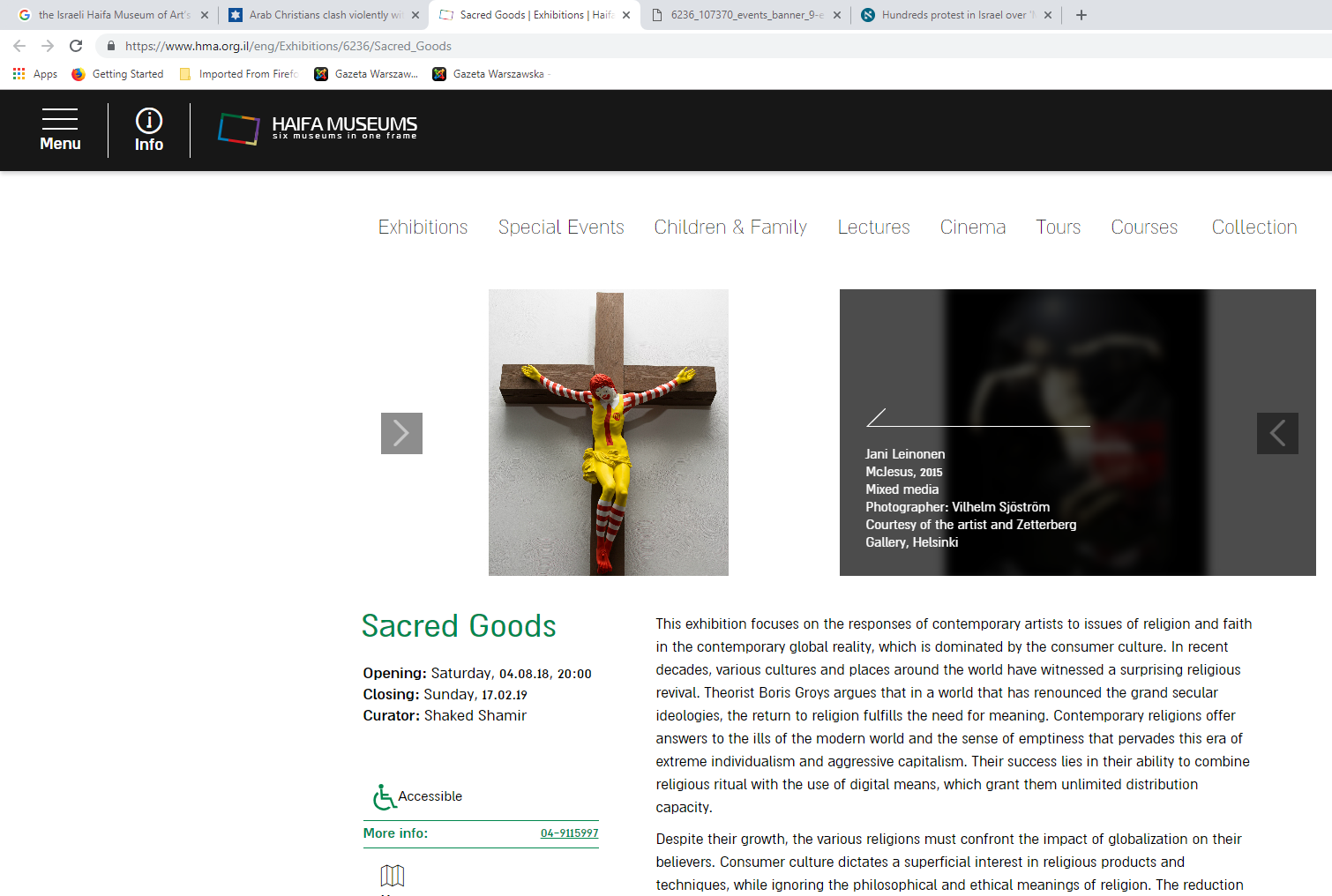
This exhibition focuses on the responses of contemporary artists to issues of religion and faith in the contemporary global reality, which is dominated by the consumer culture. In recent decades, various cultures and places around the world have witnessed a surprising religious revival. Theorist Boris Groys argues that in a world that has renounced the grand secular ideologies, the return to religion fulfills the need for meaning. Contemporary religions offer answers to the ills of the modern world and the sense of emptiness that pervades this era of extreme individualism and aggressive capitalism. Their success lies in their ability to combine religious ritual with the use of digital means, which grant them unlimited distribution capacity.
Despite their growth, the various religions must confront the impact of globalization on their believers. Consumer culture dictates a superficial interest in religious products and techniques, while ignoring the philosophical and ethical meanings of religion. The reduction of religion from a system of beliefs, values, and symbols to commodities is expressed in the works of Ido Abramsohn, Esther Naor, and Brian Ulrich, presented in this exhibition. Artists Gabi Ben Avraham and Tony Leone shift their photographical focus from the product to its buyers, thereby demonstrating the centrality of the act of shopping in constructing the identity of most of the denizens of the Western world.
Notably, the relationship between religion and consumption does not end with commodities and products, since consumption itself displays the characteristics of a religion. Already in the late nineteenth century, writer Émile Zola crowned consumption as the new religion, in which religious rituals in a church have been replaced by purchasing ceremonies at a department store. In the contemporary context, the artists participating in the exhibition employ religious symbols to criticize the encroachment of the consumer culture on our lives in general, and on the religious sphere in particular. The artists also criticize the way religions use consumer values and practices in order to prosper in the contemporary reality.
The image of crucified Jesus appears as a subversive element in the works of Jani Leinonen, Magnus Gjoen, and Nick Stern – provocative works that address the collaboration between religious systems and the consumer culture. In the local context, Ariane Littman challenges religious and state symbols, using marketing strategies in order to illuminate and critique the commercialization of the Holy Land. Vania Heymann and the artist duo Pool & Marianela take a humoristic approach, mixing icons and religious rituals with the characteristics of consumer culture.
In a reality wherein globalization aspires for cultural unification, religion offers its followers the illusion of a return to their roots and to distinctive local traditions. The return to religion, as a contemporary global trend, appears in the work of Karam Natour, which addresses the power of female deities originating in ancient traditions. The subjects photographed by Andi Arnovitz are captured in intimate contemplation of God, expressing the personal attraction to religion. The installation by Elodie Abergel draws connections between humanity's collective desire to approach God, and commodity items that embody spirituality in the material world.
Participating artists: Elodie Abergel, Ido Abramsohn, Gabi Ben Avraham, Magnus Gjoen, Vania Heymann, Jani Leinonen, Tony Leone, Ariane Littman, Esther Naor, Karam Natour, Pool & Marianela, Nick Stern
https://www.hma.org.il/eng/Exhibitions/6236/Sacred_Goods


